Total Pageviews

Wednesday, 27 January 2016

Mr Gove was criticised by a former law lord last week for continuing to detain 4,500 IPP prisoners About 3,500 of these IPP prisoners have already served the minimum punishment periods set by the courts.

Gove's actions 'give hope' for justice policy

  • 25 January 2016
  •  
  • From the sectionUK
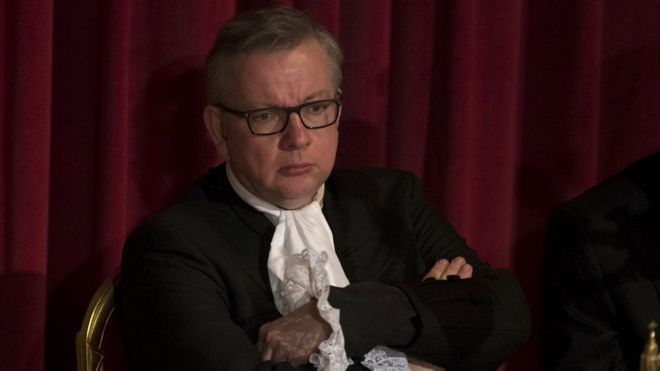
Michael GoveImage copyrightReuters
Image captionMichael Gove replaced Chris Grayling as Justice Secretary, in May 2015
A debate on prison policy in the House of Lords last week "showed how much goodwill there is for the new justice secretary", according to the Conservative backbench peer who initiated the discussion.
Lord Fowler said policies being introduced by Michael Gove, who also holds the post of Lord Chancellor, "give more hope for advance in prison policy than anything I have heard for many years".
From the Labour front bench, Lord Beecham said: "It would be churlish not to welcome Mr Gove's appointment as Lord Chancellor, although almost anyone would have been an improvement on his predecessor".
Chris Grayling was Justice Secretary and Lord Chancellor from September 2012 to May 2015, the first non-lawyer to hold the post for more than four centuries.
As such, he was never going to have an easy ride from the legal profession in his first cabinet post.
He was also required to save large sums of money from the Ministry of Justice budget, leading to cuts in legal aid and colourful protest meetings by lawyers.
Some lawyers also objected to his planned human rights changes, although in this he was merely seeking to do the prime minister's bidding and these were never implemented.
But some of Mr Grayling's less well-known policies, such as restructuring of the courts in England and Wales, are being carried through by his successor.

Pragmatism before ideology

One reason Mr Gove has earned the respect of his political opponents is his willingness to reverse many of Mr Grayling's least effective decisions.
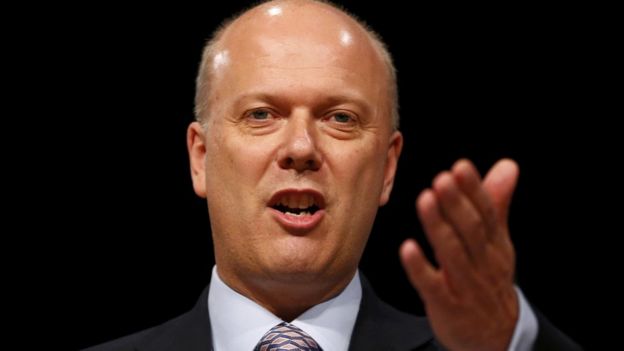
Chris GraylingImage copyrightReuters
Image captionChris Grayling was the first non-lawyer to be Justice Secretary and Lord Chancellor
There is speculation the next policy to be abandoned will involve the award of criminal legal aid duty contracts.
These contracts, under which solicitors agree to cover police stations and magistrates' courts in England and Wales, are the gateway to legal aid work for law firms.
To make up for cutting solicitors' fees by 17.5% over two years, the number of contracts was to be reduced from 1,600 to 527 - making each contract much more valuable.
But the Ministry of Justice had to postpone the new contracts - which were meant to take effect this month - after solicitors launched legal action alleging the allocation process had been unlawful.
If Mr Gove does decide to put pragmatism ahead of ideology, it won't be the first time.
A couple of months after his appointment last May, the former education secretary lifted restrictions on the number of books that prisoners could keep in their cells.
Also last July, Mr Gove scrapped plans to spend an estimated £85m building a huge prison in Leicestershire for 320 young offenders.

Judges' pay rise

Risking a clash with the Foreign Office, the justice secretary pulled out of a £5.9m prisons deal with Saudi Arabia.
This had been set up under a commercial arm of the Ministry of Justice established by Mr Grayling and scrapped by Mr Gove.
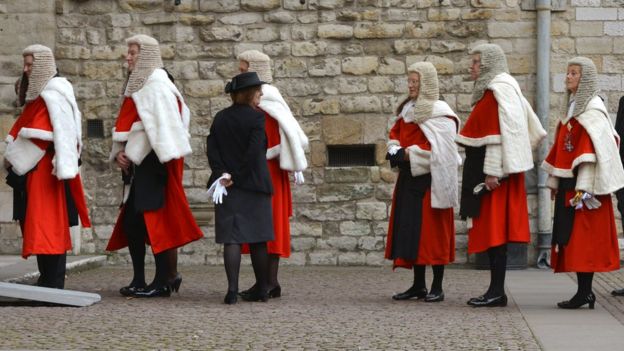
High court judges
Image captionMr Gove has established better relations with the judiciary than Mr Grayling was able to
Last month, the justice secretary abolished the much-criticised criminal courts charge, which Mr Grayling had insisted would make criminals "pay their way".
And, this month, Mr Gove supported a 3% pay rise for high court judges, to be funded by increasing salaries for the most junior judges by less than the 1% they would otherwise have received.
One reason, he said, was it had not been possible to fill a vacancy in the high court family division last year - at a time when Mr Grayling was insisting that implementing changes recommended four years earlier would have increased the total pay bill by an unacceptable 2%.

Improved relations

Despite praise for his prison policy, Mr Gove was criticised by a former law lord last week for continuing to detain 4,500 prisoners given indefinite terms of imprisonment for public protection (IPP) under a schemed abolished in 2012.
About 3,500 of these IPP prisoners have already served the minimum punishment periods set by the courts.
But the biggest difference between the two secretaries of state is the one that is the least obvious: Mr Gove has managed to establish much better relations than Mr Grayling ever had with what the Ministry of Justice regards as its stakeholder groups, notably the judiciary.
While well aware they can no longer rely on the lord chancellor being a lawyer, the judges are relieved to find the minister responsible for the legal system in England and Wales is now someone they can do business with.


http://www.bbc.co.uk/news/uk-35399272

Saturday, 23 January 2016

Even so, Lord Brown of Eaton-under-Haywood, a former justice of the Supreme Court, described IPPs as a "form of preventive detention - bring this terrible scourge to an end".

Ipp sentencing challenge
But his hands are tied because politicians cannot tell judges what sentences to pass in individual cases. What the justice secretary can do is to seek changes in the law if he thinks it is operating unfairly.

Prison population (England and Wales)
200779,734
200883,194
200983,454
201085,002
201185,374
201286,048
201383,842
201485,509
201585,884
2020 ?90,200
Source: The Ministry of Justice
A law that has come in for a great deal of criticism is the former sentence of imprisonment for public protection, known as IPP.
Offenders were given a notional minimum term, known as the tariff, but they could be detained indefinitely after that term had expired.
The sentence was introduced under the Criminal Justice Act 2003 when Lord Blunkett was Labour's home secretary, and abolished at the end of 2012, when Kenneth Clarke was the Conservative minister responsible for sentencing policy.
But abolition was not retrospective. In June this year, more than 4,600 prisoners were still serving IPPs.
By September, more than three-quarters had completed their minimum term and 392 IPP prisoners had served more than five times their tariff.
The government's policy is that IPP prisoners should continue to be detained until they can persuade the Parole Board, at a hearing, that the risks they pose to the public are safely manageable in the community.

'Terrible scourge'

But the Parole Board has a backlog of cases waiting to be heard - although that was reduced by 18% during the first 10 months of 2015 as a result of increased funding.


Even so, Lord Brown of Eaton-under-Haywood, a former justice of the Supreme Court, described IPPs as a "form of preventive detention - internment - entirely alien to our traditional criminal justice approach".
He called on the justice secretary to "bring this terrible scourge to an end".
                           
Image caption Lord Brown has been highly critical of IPPs
Although Michael Gove could do that, if he was persuaded to, he cannot issue sentencing guidelines for particular types of crime.
That's the job of the Sentencing Council, which was set up by Parliament to promote consistency in sentencing while maintaining the independence of the judiciary.
It recommends sentences according to the relative seriousness of different offences and the seriousness of the offender's behaviour relative to that of others convicted of the same offence.
Sometimes the council's guidelines are likely to result in shorter sentences (than they would have received before the guidelines were issued) and so the prison population will go down.
Some middle-ranking cases can be tried either by magistrates or by judge and jury.

From March 2016, magistrates will be encouraged not to send cases for trial in the Crown Court if they can be heard by the magistrates themselves.
Magistrates have more limited sentencing powers although, if necessary, they can send a convicted defendant to be sentenced in the Crown Court.
 
Sentencers will also be reminded to give a full one-third discount to those who plead guilty at the earliest opportunity, even if the evidence against the defendant is overwhelming.

Sometimes Sentencing Council guidelines that attempt to get the courts to pass shorter sentences may backfire and produce the opposite result.
The council's chairman, Lord Justice Treacy, recently admitted that new guidelines for serious assaults had led to longer sentences, despite predictions that punishments would be less severe. The guidelines will now be revised.

Confusion

And sometimes offenders fail to grasp how long they will spend behind bars.
Anybody convicted of murder can expect to spend 15 years in prison, or 25 years if the accused was carrying a knife or other weapon.

It is not widely understood that offenders sentenced to life imprisonment must serve their tariffs in full before being considered for release on licence, unlike other offenders who are likely to be released after serving less than half their sentences.


Prison population (England and Wales) 200779,734 200883,194 200983,454 201085,002 201185,374


Thursday, 21 January 2016

Ipp prisoners, for some of those stuck in that system the uncertainty becomes too much, 16 IPP deaths in just over 3 years, something needs to be done urgent! We need every Organisations to help, read injutice, write justice!


Last year the number of IPPs reported as self-harming was equivalent to 42 percent of the total IPP population. Some go further. Recently VICE News found that since the sentences were abolished in 2012, at least 16 IPP prisoners have killed themselves while in jail. IPP prisoners are now more likely to die by suicide than prisoners with fixed release dates.

There were a total of 250 deaths in 201...4–15, 11 (5%) more than the year before. The increase was predominantly among adult male prisoners.

Six people a week recallIn some cases it was found IPP prisoners being recalled for minor infractions of their probation terms. One man received an IPP sentence after being charged with sexual assault for grabbing a woman's behind in the line at the post office. After he was released he was recalled to prison after returning one night to his hostel drunk. He stayed in jail for a further 17 months until he could finally see the Parole Board and was released again.

4,614 people are held on the now abolished indeterminate IPP sentences, of whom 3,532 (77 per cent) have passed their tariff expiry date http://www.howardleague.org/weekly-prison-watch/
http://www.prisonreformtrust.org.uk/…/Prison%20the%20facts%…
Vice news on the IPP: https://www.youtube.com/watch?v=ldILWJ5BVWM


David Blunkett's Criminal Justice Act That allowed prisonersto be detained indefinitely requiring judges to pass life sentences on low-level offenders. The first was that offences did not have to be veryserious to trigger an IPP. "run-of-the-mill" crimes such as burglary, robbery or arson.
Offenders would serve the period they would be expecting for an offence two or three years on average, but sometimes much less – and then find themselves still in prison with little
prospect of release.
 
 If anything, that makes things worse for prisoners stillserving IPPs. If they had been sentenced after December 2012, when theprovisions were repealed, they could look forward to serving their time and
being released. The same would apply if they had been convicted before April
2005, when section 225 of the 2003 Act came into effect.we need to put an end  to this injustice and it is  now time he opens up to humanity.
 
We need more of your support, organisation  Tv  etc......


Friday, 15 January 2016

RECALL, AND EARLEY RELEASE FOR LOW RISK..

I would like to alert your readers to a significant legal case to be heard on the 9th of February 2016, R (Stellato) v The Parole Board. Currently the courts have been following the Lords decision in (West) that if you are recalled illegally or adjustably you are still legally held in prison. The House of Lords resigned from that the position in (West) at Para 74 in R (Black) v Secretary of State for Justice (2009). Lord Brown asserted that ‘It would not be lawful to recall a prisoner unless he had breached his license conditions’.

My case should clearly establish that everyone recalled has been assessed with the incorrect test as Article 5(4) gives you the right to challenge your detention and the test has to be wide enough to cover the breach. If you have not breached your license conditions then you are entitled to compensation. If successful, it will mean that everyone who has been recalled is a victim of violation of Article 5(4) if it can be shown that the court which laid down the statutory test was made per incurium. The logic and reason is with me, I conducted the research myself, and although that is only one of my grounds it may significantly alter the recall landscape.

I am further advancing vis-a-vis D cat, that a governor cannot change your categorisation if you have been released as a D cat as everyone who is recalled is presumed in law to be innocent or not to have breached their license until the State has proven it was breached and if you have to wait for an oral hearing or proceeding to Judicial Review it would be subjudice. So, not only are you not precluded from D cat on recall (PSI 40/2011: sec 5.3) but also the governor cannot claim that you did breach your license.

After I win my case on the 9th of February you should seek a new hearing before the Parole Board, or sue for damages for breach of Article 5(4) because you couldn’t effectively challenge your detention so claim damages for false imprisonment. The level of financial damages for 6 months is roughly £35,000, but with a diminishing amount thereafter – see Evans, para 7 {R (PB) – v – SSHD (2008).


Early Release Scheme

Justice Minister David Ford’s Early Release Scheme introduced on June 1st 2015, seems to have been heralded as a success with the recent release of 13 prisoners serving what constitutes as a ‘Lesser Offence’. The scheme is indeed a milestone towards the reform of the prison system in reducing overcrowding. Mr Ford, however, stated that sex offenders, terrorists and life sentenced prisoners would be excluded from the scheme. What a sweeping statement to make! Is it right that the scheme should be limited to those serving a prison term of a ‘lesser offence’ should only be considered?
Any offence that warrants a prison sentence is obviously going to be of a serious nature to facilitate the incarceration of the guilty person. Figures show that 58% of adult prisoners serving shorter sentences for ‘lesser offences’ reoffend within one year of release. It is not only those convicted of ‘lesser offences’ that can be assessed as ‘presenting a low risk of reoffending’ but also those convicted of categories not contained within the realm of a ‘lesser offence’.

Mr Ford unfairly tars, for example, all sex offenders with the same brush. My level of risk reoffending is 1.1% over two years, reducing to 0.8% over four years, yet even with a low risk of reoffending Mr Ford is excluding people like myself from being included in this scheme
.
Justice Secretary Mr Gove, on 17th of July 2015, made a speech on prison reform and confirmed the plans concerning early release for prisoners. His comments were targeted at prisoners that were motivated to working towards qualifications. He stated – ‘I am attracted to the idea of earned release for those offenders who make a commitment to serious educational activity, who show by their changed attitude that they wish to contribute to society and who work hard to acquire proper qualifications, which are externally validated and respected by employers’.

Mr Gove does not appear to endorse Mr Ford’s determination to exclude other offenders from the scheme, as it is likely to apply to most of the 86,000 prisoners serving fixed-term sentences. The scheme should encompass every prisoner within the system so that each can be judged on their individual merit, risk of reoffending, behaviour and compliance, instead of being brushed aside and labelled unworthy purely due to the ‘category’ of their conviction.

INSIDE TIMESa-signi-cant-paradigm-shift/

Wednesday, 16 December 2015

IPP,S case,s. Reviewing the position of thousands of prisoners who are still in jail despite having served the minimum jail term laid down by the courts.Get writing about your case to the Lord Chief Thomas, his address

The Lord Thomas of Cwmgiedd - the Head of the Judiciary of England and Wales and the President of the Courts of England will be hearing  12 IPP  cases.
Michael Gove  Minister for justice will be reviewing numbers of cases.

 Ipp,s family and friends I would get writing about your case. You could get support from your solicitor, a support letter or ask your Mp to help you.
Family,s you can google how to write to a lord if not well versed and send a template to your IPP further sent them articles so they can  understand what your reading.  Encourage and support them in writing there case if need be. At the bottom of the page ive added the address of Michael Gove Minister for justice .Send a copy to both  of them and keep a copy  thus saving time. Send by signed delivery this way nothing can go amiss.


Gavin Shuker, labour and Cooperative MP for Luton South

Dear Katherine

Thank you for calling our constituency office today.

You may find it useful to write formally to:

The Lord Thomas of Cwmgiedd - the Head of the Judiciary of England and Wales and the President of the Courts of England and Wales at the address below:
Judicial Office
11th floor, Thomas More Building
Royal Courts of Justice
Strand
London WC2A 2LL


We trust that this information is useful for you.

If you need assistance from Gavin with anything else in the future please let us know.

Best regards

Richard

Richard Robinson
Senior Parliamentary Assistant
www.gavinshuker.org


House of Lords information office

Dear Katherine

Thank you for your email.

If you would like to contact Lord Thomas of Cwmgiedd, he leaves the following address with us:

Rt Hon The Lord Thomas of Cwmgiedd
Royal Courts of Justice
London
WC2A 2LL
Tel: 020 7947 6776
E-mail:
thelordchiefjustice@judiciary.gsi.gov.uk

Lord Thomas
 
Image result for pic of Lord Thomas of CwmgieddImage result for pic of Lord Thomas of Cwmgiedd
............................................................................................................................................


Rt Hon Michael Gove MP Michael Gove, Minister for Justice               

Parliamentary

House of Commons, London, SW1A 0AA
Tel: 020 7219 6804
            
                           
Website: www.michaelgove.com/in...            
 

“When will the Lord Chancellor finally decide to bring this terrible scourge to an end? This is a form of preventive detention, internment, entirely alien to our traditional criminal justice approach.” These are the words of former Supreme Court judge, Lord Brown.


His Lordship was talking about a scar that has defaced the penal system since 2005, with the introduction of Indeterminate Public Protection (IPP) sentences.

They were introduced two years earlier with the intention of protecting the public from people who had committed serious offences, but not deemed so grave as to warrant a life sentence. Offenders sentenced under IPP rules were given a minimum term (tariff) to serve in prison.

When that tariff point was reached, IPP prisoners could apply to the Parole Board for their freedom.

Catch 22

Almost immediately after their introduction, prison watchers realised that IPPs represented a classic Catch 22 situation.

To convince the Parole Board they no longer represented a threat, IPP prisoners had to complete certain offending behaviour courses, according to the nature of their offence.

But these courses were not available across the entire prison estate. So, you could not be released until you had completed the programme, but the programmes were not available in the numbers required.

Systematic failure

IPP prisoners began to clog up the system. The more they did so, the less the programmes became open to them.

The Court of Appeal quickly recognised this catch and in 2007 judges ruled the Secretary of State had acted unlawfully in introducing IPPs.

They condemned the “systematic failure to put in place the resources necessary to implement the the scheme of rehabilitation required-under the Act.”

It was not until 2012 that the government scrapped IPP, replacing it with new sentencing guidelines.

But the changes were not retrospective and IPP prisoners continue to be held many years after their tariffs have expired – and still unable to complete the courses that were the keys to their freedom.

Currently 4,614 people ares still being held on IPP sentences, of whom 3,532 (77 per cent) have passed their tariff expiry date.

In some cases, prisoners given a minimum tariff of two years were counting their years in double figures....

Log jam

In this month’s edition of Inside Time, an IPP prisoner who in 2008 was given a tariff of six years states his case.
He has been a model prisoner: never committed an offence against prison rules and been on enhanced status for six and a half years. He has completed 23 offending behaviour courses but remains stuck in the log jam in a Category C prison.

He appears to be a victim of the intolerable pressures put on the Parole Board, who simply do not have the resources to cope with the demand.

 And who, no doubt, are terrified of getting it wrong and releasing a person who may re-offend, and o incurring the wrath of the right wing press.The Catch 22 nightmare still applies, three years after IPPs were scrapped.

One solution

The failed IPP system is just one of the many problems facing new justice secretary Michael Gove.
Under current rules, he still has to wait until the Parole Board clears the log jam, which will likely be 8 years down the line.

I offer one solution to at least improve the situation.
The Parole Board carries out a thorough risk assessment before releasing a prisoner.

During this time inmates serving IPP sentences may well be held in open prisons, to help them adjust to life in the outside.
But to get to an open jail, prisoners undergo a thorough risk assessment and, of course, they could walk out of their jails whenever they choose. By staying there, surely these men have proved they are not a risk.
Common sense and justice should prevail.

This ugly stain on the criminal justice landscape can and should be removed forthwith.
prisonwatchuk.com/2015/12/15/the-ugly-stain-of-ipp-indeterminate-sentences-comment-from-eric-allison/

, , , , , , , ,

Tuesday, 15 December 2015

IPP CASES. I would get writing to lord chief justice Lord Thomas or Michael Gove minister for justice.""

Monday, 14 December 2015

Lord Chief to hear 13 IPP cases together to give a consistent approach to the older cases. 8 December 2015 with Baker J and McGowan J.


Michael Gove is reviewing the position of thousands of prisoners who are still in jail despite having served the minimum jail term laid down by the courts, The Times can reveal.

The inmates are caught in a Kafkaesque situation in which they remain behind bars because they cannot prove to the Parole Board that they are no longer a risk to the public.

One prisoner is in jail ten years after he was given an indeterminate sentence for stealing a phone, with a recommendation that he serve a minimum term of 12 months.

 
Janet Boden. The important bit from this article ...."There is one piece of news. On 10 December 2015, in the Court of Appeal, the Lord Chief Justice will hear about a dozen beyond-tariff IPP cases. I am involved in one of the cases and I understand that all the defendants are challenging the imposition of IPP rather than detention beyond the end of the tariff. Normally when a series of cases are linked together this is because the Lord Chief Justice wants to issue new guidance."

 
 Links:
 

OFFENDERS MAGEMENTS Statistics Bulletin covers the prison population as at 30 June 2015 and the probation .... first time more than three quarters of IPP prisoners are now post-tariff. ... Statistics publications on the Criminal Justice System in the Ministry of justice.
file:///C:/Users/user/AppData/Local/Microsoft/Windows/Temporary%20Internet%20Files/Content.IE5/VQL3TZUI/offender-management-statistics-bulletin-jan-mar-2015%20%281%29.pdf

The times IPP:
http://help.thetimes.co.uk/site_timesarticledetail?categories=Exclusive_Memberships_Offers&id=000007961&retURL=site_timeshome&searchtext=&type=Non-Member

Robert Banks receives letters from prisoners asking for advice. from those who have received unlawful sentences. Each one is answered and a selection of answers are published in Inside Time, the prisoner's newspaper.
The prisoners whose letters are published consent to the replies being published. However, no details which would identify the prisoner are given.
Only letters sent via a solicitor can be answered. Letters sent direct will be returned. Serving prisone...rs should send their letters to Inside Time, who will send it to a solicitor.