Thursday, 8 December 2016


Monday, 5 December 2016
Treatment of prisoners serving the unjust IPP sentences is in need of urgent action.

Completely unjust” that offenders serving Imprisonment for Public Protection (IPP) terms were languishing in jail.
The implications for many of these prisoners are profound and make for disturbing reading. Recent figures show that for every 1,000 people serving an IPP sentence there were 550 instances of self-harm. This is significantly higher than the 324 cases per 1,000 recorded among the general prison population.Vice News reported that information from the Ministry of Justice showed 16 IPP prisoners committed suicide since the abolition of the sentence in 2012 and that IPP prisoners overall have a higher risk of suicide than the general prison population.
The high levels of self-harm are perhaps unsurprising. IPP prisoners are often simply unable to jump through the relevant hoops set by the Ministry of Justice to achieve a release date, leaving many feeling that they will be stuck behind bars for years to come, no matter what efforts they make to reform.By Claire Brihgam Hodge Jones & Allen Solicitors London180 N Gower St, Kings Cross, London NW1 2NB
IPP Prisoners no linger need oral hearing. New strategy to eradicate backlog. Changes and ‘good plan’ to reduce delays in parole process.
As promised, I am writing a regular update on news and developments from the Parole Board. There is so much change going on within the prison and probation service and the impact on you is not lost on everyone working at the Parole Board.
I know from my visits to prisons that one of the single, biggest issues concerning many prisoners is the long delays experienced by those of you who need your parole review considered at an oral hearing. All of us at the Parole Board are determined to sort this. The Parole Board is now holding five times the number of hearings it held a decade ago but for a period of time we could not keep up with demand. We have a new strategy to improve the system however the top priority is to eradicate the backlog.
The Board is already over halfway to reducing the backlog, and we are focused on reducing delays even further. I am confident that we are approaching this in the right way. At the end of September 2016, there were 2,093 outstanding oral hearings, and whilst still too high (at its highest point the figure stood at 3,163) it was the lowest level since summer 2014. We continue to list close to 700 cases a month at oral hearing and where hearings have to be cancelled we are attempting to fill those hearing slots with alternative cases.
As covered in the last edition of Inside Time, we are running pilots to change how we prioritise cases. We are looking at different ways to manage determinate sentence prisoners, including where more executive re-releases could safely be made by NOMS and how we could increase the release on the papers. These changes are intended to rebalance the system and bring down delays for those serving the longest sentences. This is about striking a reasonable balance, but I acknowledge that these involve hard decisions and there may be an impact on some of you affected by the pilots. We will be reviewing the impact of the pilots early next year.
On 22 November 2016, the Parole Board Rules were changed to allow the Board to release IPP prisoners ‘on the papers’ without an oral hearing. This change brings the release provisions for IPPs into line with those for parole-eligible determinate sentences and it applies to both parole reviews and to reviews following recall. We anticipate that the new powers will be used more frequently
for recalled prisoners who have only been back in custody a short time but it can be used for parole prisoners, especially those in open conditions and the progression regime. The Rule change does not apply to life sentence prisoners who can still only be released following an oral hearing.
You may have read about the report produced in November by Peter Clarke, my successor as Chief Inspector of Prisons, about IPP prisoners. I completely agree with what he said and I have given the Justice Secretary options about how we can make further and faster progress in reducing the number of IPP prisoners who remain in prison long after their tariff.
Following the appointment of over 100 new Parole Board members by the Lord Chancellor, the first of our training events took place last month. New Parole Board members heard from a variety of speakers including Inside Time editor, Erwin James. Erwin spoke about his journey as a life sentence prisoner, including contact with the criminal justice system in his early life, his experiences in prison, his challenges on release and becoming a writer. He spoke about the importance of professionals and practitioners promoting self-belief and taking control of your life, and providing opportunities for change. The Parole Board also produced an excellent short video of interviews with three prisoners currently serving life sentences at a Cat C prison. The members told us how this gave them an invaluable insight into life in prison, the parole process and oral hearings from a prisoner’s perspective. I want to thank the prisoners who took part in that for their help.
Of course it is also important that Parole Board members hear from victims about their experiences and concerns too. We train our new members in handling victims with humanity and respect. We know that most victims are looking for an explanation of what motivated the crime, as this is never really explored at court. I have met with several victims and victims’ groups to help make sure that victims are handled sensitively and properly when they attend hearings and in my experience most prisoners who come before us want to make sure that happens too.
As we come to the end of 2016, I am hopeful that we have a good plan for what we need to do to make the Parole Board work better for prisoners and victims and what we are doing now is getting on with it.
The Parole Board Rules are being revised and the changes could have a significant impact on those sentenced to Imprisonment for Public Protection (IPP)
The proposed changes include the ability for the Parole Board to release IPPs without the need for an Oral Hearing. With Christmas and New Year fast approaching, could this rule change make a difference to you?
What is an IPP sentence?
Imprisonment for Public Protection (IPP) sentences were introduced in April 2005 by the Criminal Justice Act 2003. The aim of the sentence was to protect the public from
those offenders who committed crimes which did not merit a life sentence. Prisoners serving this sentence would be set a minimum term (tariff) which they must serve before they could be considered for release. Upon release prisoners will be supervised on licence for at least 10 years.
Under the Criminal Justice Act 2003 the Court will impose an IPP sentence when the Offender:
1. Is aged 18 or over;
2. Is convicted of a serious specified violent or sexual offence committed on or
after 4 April 2005, for which the maximum penalty is 10 years or more; and who
3. In the courts opinion, poses a significant risk of harm to the public.
When first in force a significant amount of offenders were subject to this new sentence. As a result the prison system was saturated with indeterminate sentence prisoners with relatively short tariffs. Many prisoners past their minimum term without having completed any offence focused work due to the prison system being unable to cater for them.
What has changed?
Due to the significant amount of offenders given a sentence of Imprisonment for Public Protection the Government made changes to the criteria required to impose such a sentence. On 14 July 2008 changes were made virtue of Schedule 8 of the Criminal Justice and Immigration Act 2008. As a result, IPP sentences could only be imposed if one of the following were met:
1. The offender would be required to serve at least 2 years in custody; or
2. The offender has a previous conviction for one of a specified list of very
serious offences.
In addition to the above the presumption of risk was removed where there was a previous conviction for a violent or sexual crime. Previously, judges presumed an offender dangerous as a result of their previous convictions. The change made in
2008 allowed for a greater level of discretion as to what sentence should be imposed
when all of the conditions for the imposition of an IPP sentence were met. The aim of this was to reduce the number of IPP sentences being imposed by Courts.
Finally, in 2012 the Legal Aid Sentencing and Punishment of Offenders Act abolished IPP sentences. The IPP sentence has been replaced by Extended Determinate Sentences (EDS). The changes made in 2012 were not retrospective. As a result, whilst no new IPP sentences could be imposed, those who were already subject to the sentence would have to seek progression by the Parole Board. This
has left a significant amount of IPP prisoners within the prison service still seeking
progression.
Current procedure for release of IPP
The process as it stands for the progression of IPP prisoners is that the Parole Board will give consideration to their case. For prisoners’ post tariff, the Parole Board will first consider the case on the papers and either find them unsuitable for release or direct the case to an Oral Hearing. Should release not be granted, the Secretary of State will set a period of review before the Parole Board will again consider suitability for progression. This review period will depend on what is outstanding to achieve a progressive move.
Under the current regime the Parole Board have no power to direct a prisoner’s release on the papers. To achieve release, oral evidence must be taken before the decision is made. Currently the Parole Board have a significant backlog of Oral Hearings and as such there are delays in IPP prisoners appearing before the Board.
Rule Change
The Parole Board Rules 2016 look to revoke the Parole Board Rules 2011 and the Parole Board (Amendment) Rules 2014. The proposal is for the rules to come into force from 21 November, assuming that neither the House of Lords nor House of Commons object to the proposed changes.
Rule 14 seeks to allow the Parole Board to decide that a prisoner serving a sentence of Imprisonment for Public Protection is suitable for release on the papers, without the need for oral evidence. This change will not apply to any other indeterminate sentence prisoner – it will only apply to IPPs.
A number of other rules are proposed, including the requirement of a prisoner to
inform the Parole Board that they do not wish for oral consideration of their case or that they do not wish to attend a hearing.
What will this mean?
There is now potential for IPP prisoners to have their reviews completed earlier. Currently, release will only be directed upon the taking of oral evidence, even in circumstances where a prisoner has support from professionals involved in their case or in circumstances where a minor and technical breach of their licence has led to their recall into custody. The ability to direct release on the papers will potentially reduce delay caused by the listing of an oral hearing.
Of course there is no guarantee that the Parole Board will release IPP prisoners on the papers. More complex cases will still proceed to an Oral Hearing for the Parole Board to fully enquire into all matters relevant to a prisoner’s release. It is envisaged that the rule change will assist those IPP prisoners who have been subject to a technical breach of their licence following their release into the community and where release is more straightforward.
The 2016 Rules will apply to all cases referred to the Board; including cases referred before the date on which they come into force. As a result, cases referred to the board before the date on which the new Rules come into force will continue under
the 2016 Rules.
What can you do to help?
The current test for the Parole Board for the release of an IPP prisoner is as follows: The Parole Board will release an offender only if it is satisfied that it is no longer necessary for the protection of the public for the offender to be confined.
In order to secure release an IPP prisoner will need to demonstrate that their risk is
such that it is manageable in the community. This can be achieved by the completion of offence based courses aimed at addressing risk factors. It is also important to engage with Offender Manager and Offender Supervisor and to demonstrate compliance within the custodial setting. A resettlement plan will also assist to demonstrate how the prisoner seeks to cope upon their release back into the community.
What can we do to help?
We would encourage all IPP prisoners to contact us when their Parole Review commences. When the 2016 rules come into force, legal representations will be required to argue for release on the papers in appropriate circumstances. This could save the delays experienced by many prisoners in obtaining release by way of an oral hearing. Subject to your financial circumstances, assistance can be provided by virtue of Legal Aid.
COMMENTS
Andrew
Sperling @AndrewSperling Politicians won't take responsibility for tackling
IPP while in office. When they leave they speak up - Gove, Clarke, Blunkett .
Ben Gun @prisonerben1 Until we decide the purpose of prison, we can't say
what we need from prison staff. The indefinite prison
sentence is the most vicious punishment at Governments disposal.
BrackenburyThe more I sit and think it over the more I don't
understand how the MOJ and parole board, are not facing charges or being sued ,
getting away with something that is in every other humane aspect ILLEGAL!! It
is unlawful to hold someone in prison for what they MIGHT do it's unlawful to
torture a prisoner in Britain, and to their loved ones, let alone just damn
right immoral and inhumane! If our loved ones can be imprisoned for their
crimes, how on earth is it not applicable for the way the legal bodies behave!
Think it's time that us loved ones considered pursuing a way to have them
bought before the courts for still implementing and incarcerating people for a
sentence that no longer exists and for almost five years now too!! My
other partner put in for compensation after they messed him
around for a year with his hearing etc... He got 400 pound!! Legal
expenses joke!! Never mind the mental torture me and our kids have gone
through! I wonder if they were pursued for criminal charges for this
sentence by enough ppl would it change anything??
Jayne They've got no
idea what were all going through never mind our loved ones currently just left
to suffer in prison fighting to try get a parole date to try be released the
system is disgustingly out of order
Umm The pain every day they don't understand the
pain I have each day and it's really does break down my soul and mind but they
don't seem to really care we are all going though it and this government really
needs to start doing what they said their going to do.
Probation
unusual activity at Leicester probation, been trying to contact them so i don't miss my appointments, not been issued a date for next appointment, today i had a different officer check, nothing on the system still, said they will get back to me when my next appointment is, that is what they said last time. not sure what they are up to, i'm hoping they don't just put one on the system and not tell me then recall me for missing it to be honest i wouldn't put that past them.
They lied about my family who are not criminals and an MP signed a complaint with about 10 different points made in it, they responded to 1 point and acted as if that was the only allegation.
plus because the license is cause for fear of further draconian indeterminate imprisonment it counts as a factor to asylum claims which is what i've been threatening to do. now i don't know what's going on so i just want to notify people what's going on to create a fall out, so it's not worth it to put me away. Why keeping people in the dark . for me it only makes me dislike them and everyone has an issue with them thanks for reading.
Ginge Call them every week, worried about the time lapse between appointments make sure they log the calls, been threw this a lot of times.I Had the same issue I was worried about missing a appointment and being recalled and when my officer went sick there was 4-5 months of not noing anything till she was bk I just Keept on there case.
They lied about my family who are not criminals and an MP signed a complaint with about 10 different points made in it, they responded to 1 point and acted as if that was the only allegation.
plus because the license is cause for fear of further draconian indeterminate imprisonment it counts as a factor to asylum claims which is what i've been threatening to do. now i don't know what's going on so i just want to notify people what's going on to create a fall out, so it's not worth it to put me away. Why keeping people in the dark . for me it only makes me dislike them and everyone has an issue with them thanks for reading.
Ginge Call them every week, worried about the time lapse between appointments make sure they log the calls, been threw this a lot of times.I Had the same issue I was worried about missing a appointment and being recalled and when my officer went sick there was 4-5 months of not noing anything till she was bk I just Keept on there case.
Thursday, 1 December 2016
Prison is a Death Trap for those prisoners with an IPP and learning disblities .
I sometimes feel I am beyond shock at the iniquities that the system delivers. the inquest into his death in custody and listened to evidence that stunned and angered me. verdict delivered last Friday.
The jury at Bolton coroner's court had listened to five weeks of evidence about the circumstances of Jake Hardy's death though he is not an IPP there has been 16 IPP deaths . He was 17 years old and life had not dealt him the best hand. He had mental health problems, learning difficulties and suffered from attention deficit hyperactivity disorder ADHDHe was charged with common assault. He was then involved in a brawl and charged with affray. Tried separately, he received a total of six months' imprisonment and was sent to Hindley young offenders institution (YOI) near Wigan. It was his first time in prison.
Almost from day one, he became a target of bullying. He was a big lad, 6ft 4in, but his mother says he had the mind of a child. Other inmates told him that he smelt, threatened to "stab him up" and made disparaging remarks about his mother and family. He complained to various members of staff, but no action was taken against his abusers.
Bullying is rife in YOIs and there are supposed to be measures in place to combat it. Jails have safeguarding teams but Hardy received no protection from them.
He was also allocated a "personal officer". This role was created in the 1990s and was seen as raising the status of uniformed staff. Officers are allocated a small number of prisoners to support. They are supposed to know the history of their charges, so as to help them through problem periods.
Hardy's personal officer gave evidence at the inquest. He told a clearly shocked jury he had not read about Hardy's background, so knew nothing of his learning disabilities, his mental health issues or history of self-harm. He thought Hardy was a big lad who could "look after himself".https://petition.parliament.uk/petitions/168137
The jury found that Jake's death was contributed to by failures to give him enough support, record his suicidal thoughts and reports of verbal abuse, and move him to another cell. On the day he died, there were also failures to let him use the phone his mum to protect him from other inmates.
Forty four days into his sentence, Hardy cracked under the abuse. He smashed his television up and cut his arms. But even that did not raise alarms.
Two nights later, staff forgot to allow Hardy to phone his mother. He did not associate with other prisoners because of the bullying. He often cried when on the phone to his mum, resulting in further abuse.
He was told he could use the phone after the association period ended. The jury were shown CCTV footage of the association period, and inmates are clearly seen winding Hardy up through his cell door. The two officers on duty, including his personal officer, do nothing to prevent the abuse. Hardy responds by kicking his door and was told he would not be allowed his phone call. Nor, when association ended, was he given hot water to make a hot drink. All the other inmates, including Hardy's abusers got their hot water as usual.
His personal officer told the jury the phone call and hot water were refused because the staff could not "reward bad behaviour". Hardy killed himself an hour later.
His personal officer told the jury he no longer worked at Hindley. The prison service will not tell me the circumstances of his departure.
Earlier this year, the government announced the setting up of an independent inquiry into the deaths in custody of 18- to 24-year-olds. Some 156 young people in that age group have ended their lives in custody in the past 10 years. Shamefully, the inquiry will not cover the deaths of children under 18 who have died behind bars in YOIs and secure training centres. So the Labour peer, Lord Harris, who will lead the inquiry, will not look at the shocking neglectful treatment handed out to Jake Hardy.
Deborah Coles is co-director of Inquest, which supports the families of those who meet their deaths in custody. She says a full review of all the deaths is needed, looking at not just the fatalities, but at the reasons why young people end up behind bars in the first place.
I said Jake's vulnerabilities dealt him a bad hand in life; a psychiatrist at Hindley told the jury that a "high proportion of inmates at the jail presented with similar problems". We also know that about 60% of young people in custody have been in care at some stage in their lives; was ever a word so misused as care, in that context? It's bad enough that we jail kids who need treatment and not punishment, but to fail them then, in the way that Hindley failed Jake Hardy, is nothing less than a state-committed crime.
https://www.theguardian.com/society/2014/apr/04/prison-officer-failings-death-jake-hardy-hindley-bullying?CMP=twt_gu
DEATH IN PRISON THIS YEAR 2016 IS A RECORD HIGH OF (32)
http://www.inquest.org.uk/statistics/bame-deaths-in-prison
A disabled person is defined as having "a physical or mental impairment which has a substantial and long-term adverse effect on their ability to carry out normal day-to-day activities." Substantial is defined as ‘more than trivial’.
"In some cases, people have coping or avoidance strategies which cease to work in certain circumstances (for example, where someone who has dyslexia is placed under stress). If it is possible that a person’s ability to manage the effects of an impairment will break down so that effects will sometimes still occur, this possibility must be taken into account when assessing the effects of the impairment."
organisations therefore carry a responsibility for identifying those affected and for making suitable provisions for helping to overcome its negative effects (HMG, 1995)
by aiding and accommodating under the disability act.
“Dyslexia is a learning difficulty it does not just effect accurate word reading and spelling the characteristic features of dyslexia are difficulties in phonological awareness, verbal memory and verbal processing speed. Co-occurring difficulties may be seen in aspects of language, motor co-ordination, mental calculations, concentration and personal organisation, but these are not, by themselves, markers of dyslexia. The most significant problem with this and most other definitions of dyslexia, however, is that it loses sight of the fact that dyslexics are people having difficulty in coping this being a snap shot.
Dyslexia Co morbid is more than one disability overlapping others being Dyspraxia Asperger's and ADHD. Effects you expressing yourself cognitive and sensory abilities phonological awareness.Comorbid subjects show a neuropsychological profile characterized by failure of various cognitive functions with an additive-effect that can determine more severe functional deficits. Comorbid a marker for ADHD with more severe cognitive deficits, and a worse neuropsychological, academic, and behavioral outcome.
Failed Twice
Failed by the school failed by the prison. Those with dyslexia or other are failed in schools BECAUSE they given a one way or know way learning system that does not fit all. Number land up in prison. It is a well known that those with disability's stay in prison 2-3 times longer than other prisoner, often unable to assert themselves and unable to cope with the stressful situation or environment there in that suicide becomes there only answer .His disability was ignored by unstrained members of staff who failed in his act and dismissed his cry's. Unnoticed until an inquest?
Accountable for further failing to prisoners
The most common complaint in prison came from those who – like an estimated numbers of prisoners – identified as having learning difficulties and disabilities.
Often, they said, they had gone undiagnosed during their early education (42% of all prisoners have been excluded from school) and there had been no proper screening when they entered the prison system, no tailored provision at the jail, and therefore no means or incentive for them to engage in education.
The hard-pressed head of learning and skills at the prison looked away. Later she spelled out the problem for us. If her prison – and prisons across the system – assessed and then responded as best practice to such large numbers with learning difficulties, it would swallow the whole education budget of around £130m for a prison population of 86,000. And where did that leave the other inmates? It was a stark illustration of the strains on the system.
Heads of learning and skills don’t even sit on the senior management team in most jails. When Ofsted turns up at the gates, as part of a wider evaluation carried out by Her Majesty’s Inspectorate of Prisons, it can rate education provision as inadequate or requiring improvement (as it did in 34 out of 45 inspections in 2014-15) without it having any effect on the establishment being rated good or outstanding. Indeed, in those prisons where education is repeatedly judged inadequate by Ofsted, there is apparently no consequence at all for the governor. In a school, the head would be lucky to keep his or her job, but that is presumably because education matters there. Social development Providers get paid by putting bums on seats in classes for English and maths. But they know – as some of their senior officials told us – that the set-up isn’t working.
And what of the impact on reoffending by those serving longer sentences when they are released from internet-free prisons without any of the IT skills that are obligatory to get a job or claim a benefit?
Comments
Menard My daughter has been diagnosed with Autism and other overlaps but yet since from the schools stand point her grades are good and she seems OK their not doing anything. They totally disregard what a psychiatrist has diagnosed her with and a doctor. This system is flawed and I feel like I am always fighting for my daughter. I feel for everyone going through this it's so heart-breaking.
Dyslexia increase awareness and understanding
Wednesday, 30 November 2016
57 IPP prisoners were sentenced to less than 9 months before 2008...all of whom are still in prison. 650 prisoners sentenced before 2008 to an IPP of less than 2 years:
Eight of these prisoners concerned were given tariffs
of less than three months. Twenty-two of them were given tariffs of less than
six months;
27, tariffs of less than nine months;
64, tariffs of less than 12 months;
88, tariffs of less than 15 months;
114, tariffs of less than 18 months;
and 327 of them, tariffs of less than 24 months.
That makes 650 in all. The current assessment in relation to
500 of those 650 prisoners is that they present a very low or, at most, a
medium risk of reoffending. The question arises as to how that can possibly
have been allowed to happen. Those 650 are still in prison six, seven or even
eight years after they completed those very short tariffs. How is this
justified?’’
SEPTEMBER AND STILL WAITING ?
” Most lawyers regard IPPs as a stain on the justice system, it is just a question of when some minister has the courage to put up with the morning’s bad press
Speaking on the BBC’s ‘Inside Out’ programme he said; “Most lawyers regard IPPs as a stain on the justice system, it is just a question of when some minister has the courage to put up with the morning’s bad press. Getting rid of these IPPs was one of my top priorities. We are considering these proposals and will update on our plans in due course.”http://www.insidetime.org/more-pressure-to-release-ipps-from-former-justice-secretary-ken-clarke/
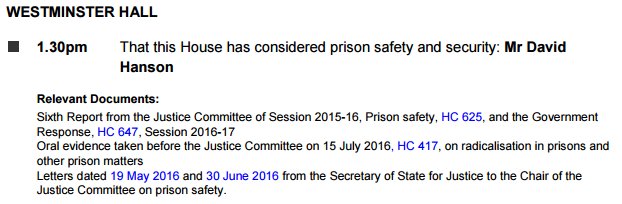
The response from the Government to the Justice Select Committee’s (JSC) report on prison safety, published last May, was so unsatisfactory that the Committee held a debate in Westminster Hall in September.
The government then pledged to produce a Prison Reform and Safety Plan, which so far has not been forthcoming. When pressed about whether his committee supported the Prison Governors Association’s (PGA) call for a Public Inquiry into the state of our prisons Bob Neill MP, a barrister for 30 years and Chair of the JSC said: “What I’d like to see first of all is for the government to produce that Prison Reform and Safety Plan they said they were going to. I think we need that urgently. I’m not sure about a public inquiry being the right way, but I do think there needs to be a public debate. We do have to have a national debate about what our prisons are for and are we getting it right in terms of the number of people we send to prison?
And what we do with them while they are there. I was very keen on the approach that Michael Gove was taking when he was Secretary of State – and I think in fairness, now she has got her feet under the table, Liz Truss is making it clear that she wants to go down the same route. That involves committing some resources from the government. My job as chairman of the Justice Select Committee is to keep up the pressure so they carry on with those reforms.”
I asked him to clarify exactly what a ‘select committee’ is. He explained that each government department has a select committee which shadows that department and acts as a scrutinising and monitoring mechanism on government. The committee is called ‘select’ because its members are selected from across all parties in the House of Commons. The justice committee looks at Justice and the agencies which answer to the Ministry of Justice, i.e. NOMS, the Prison Service, the Probation Service etc. The JSC also oversees the work of the Attorney General, the Solicitors Office and the Crown Prosecution Service (CPS). And they visit prisons.
Does the committee have any real power to change anything though? “We work by gathering evidence, holding inquiries,” he says. “All our hearings are in public and broadcast on the Parliament TV channel. At the end of our hearings we publish a report and the rules are that the government is obliged to respond within 60 days. If we’re not happy with that response we can get a debate tabled in the House of Commons.”
But does the committee have any real teeth? “It’s got actual teeth,” he says, “because we have the right to demand that people appear before us, we’ve got the right to ask for the disclosure of papers – we can grill people – and then we’ve got the power to name and shame if you like, which is quite an important power in politics.” Like the PGA, Neill says the JSC is concerned about the way prison officer numbers have dwindled over the past few years. During prison visits Neill says the committee “gets the sense of staff frustration,” and cites the figures. “Last year NOMS recruited about 2200 officers, but because so many had left they were only about 400 better off.” The fact is, I tell him, too many officers have only been in post for less than a year.
“Yes that’s right,” he says. “We’re losing experienced officers. That’s why in our safety report we were calling for an action plan to tackle safety in prisons and that’s got to include issues around staffing. Why aren’t we retaining experienced officers? That’s absolutely critical. If we don’t get satisfactory answers from this Prison Reform and Safety Plan from the Secretary of State then clearly we’re going to push very hard, because that’s fundamental.”
As a Conservative MP, I asked him if his role as Chair of the JSC might be compromised when he might have to be critical of the Conservative
government. Is he afraid of holding back? “All select committees seem to work best when they work cross party and that’s what we seem to do,” he says. “Our report on prison safety for example was agreed by consensus by all members on all sides. We’re there not there purely as party politicians we’re there as a committee to do a job for the House of Commons, holding the executive to account and that applies whichever party is the executive.” So you don’t have any qualms about coming down hard on your Conservative colleagues in power?
“No, not at all. Part of my job is to come down hard. It’s a bit like a judge has to come down without fear or favour if you like. We try and work constructively with government. There’s no point in taking party political pots for the sake of it. A good example is when we were very critical of the Criminal Courts charge that (former Justice Secretary) Chris Grayling introduced. We published a report that was quite damning about that. Michael Gove read it and listened and scrapped it.”
And why was he so unimpressed with the new Justice Secretary, Liz Truss when she appeared in front of the select committee recently? “I personally was disappointed when Michael left as I thought he was committed and clearly passionate about the job. I think perhaps Liz was taking her time to get prepared and ready for the brief. Perhaps she didn’t do herself justice at that appearance. Since then we have had constructive discussion with her and her ministers. We were frustrated because there wasn’t very much information coming out.
Maybe that’s because the new government was playing its cards close to its chest. But our job is to get that information out of them. Now we’re getting more and we need to move on. Now she has said she is committed to the reforms, now they have said that there will be a Prison and Courts Reform Bill, that was one of the uncertainties –
maybe they wanted time to think as to how they scoped it – it just might have been better if they’d said that rather than causing uncertainty. But I hope they’ve learnt a lesson from that, and now if they’re going forward with it, genuinely, then we’ll want to scrutinise that and make sure it delivers on the changes that we need.”
Earlier this year the JSC called for Restorative Justice (RJ), the practice of bringing together victims of crime and those who have offended against them. I asked Neill what led the committee to that conclusion. “As part of the package RJ has got two things to offer. One, it gives victims a say in the process and for some people that can make a real difference in getting over the trauma. It’s also very often constructive for the offender, in bringing them up sharp and bringing them to terms with the human cost of what they have done. It doesn’t work in every type of case, but we think it should be available in the mix. And it’s part of a broader and more sophisticated range of ways in which we punish people. You can link restorative justice with community sentences, and I believe we ought to be trying to reduce the prison population. I think alternatives that are robust are important and restorative justice helps on that and there is evidence that it can reduce reoffending, and that has got to be the key which is in everybody’s interests.”
Comments
Benno I
received a sentance of 2 years 82 days and I have never been to cat,d I have
been in prison for 10 years now and I just received another 12/24 month knock
back. Its ridiculous how I'm being treated I'm a cat,c prisoner in a cat,b
jail. . I have 2 co-defendants who both received 2 years straight sentence and
one of them got a suspended sentence. But yet here I am 20 years later still
serving an IPP sentence. It doesn't exist anymore its psychological torture. I
only just turned 18 when I committed my offences I'm now 28 years old I'm gona
be at least 30 when I see me progress on my sentence. Feel like I'm fighting a
losing battle. i have done my semtance 3 times over and i should not be here
Never mind adding on more which should not count asi have been hel here know
fault of my own . You have informed the public all those over tariff will be
released by 2017 those first being the logest over sentance and all other that
are still serving there sentance or those with mental health issues by 2020.
Katherine Gleeson who met you at the meeting is awaiting my outcome. 327 of us,
tariffs of less than 24 months.
The current assessment in
relation we present a very low or, at most, a medium risk of reoffending.
The question arises as to how
that can possibly have been allowed to happen. still in prison six, seven and
even eight years after they completed those very short tariffs. I have got
trapped here .
The more I sit and think it over
the more I don't understand how the MOJ and parole board, are not facing
charges or being sued for doing and let's face it, getting away with something
that is in every other humane aspect ILLEGAL!! It is unlawful to hold someone
in prison for what they MIGHT do it's unlawful to torture a prisoner in
Britain, and to their loved ones, let alone just damn right immoral and inhumane!
If our loved ones can be imprisoned for their crimes, how on earth is it not
applicable for the way the legal bodies behave! Think it's time that us loved
ones considered pursuing a way to have them bought before the courts for still
implementing and incarrcarating people for a sentence that no longer exists and
for almost five years now too!! My other half did put in for compensation after
they messed him around for a year with his hearing etc... He got 400 pound!!
Legal expenses took that!! joke!! Never mind the mental torture me and our kids
have gone through! I wonder of they were pursued for criminal charges for this
sentence by enough ppl would it change anything??
Page It all so
wrong what there doing two ipp prisons the mh there must be going through there
done there time and more let them out full stop god b ap
McSherry
I was 3 and a half years over tariff on parole delays alone....apparently you
can claim compensation for such delays.....but no one wants to take the cases
and fight it.....
Queen 2 years doing 11 years
Stanley 2 years done 8 years
Nokes 15 months would done 9 years death by suicide December 23
Letter to Liz Truss
Katherine Gleeson
Bedfordshire
katherinegleeson@aol.com
25th November 2016 .
The Rn Honourable Elizabeth Truss
Lord Chancellor and Secretary of
State for Justice Ministry of Justice,
102 Petty France, London,
SW1H 9AJ
Dear Ms Truss
My name Katherine Gleeson i am founder
of IPP petition and family campaign blog
I am writing to request a meeting
with you, to discuss the IPP prisoners’ continued incarceration and furthermore
the effects on the families. The government has deliberated for years and now
it is time to act on the options given and address the injustice of the IPP as
a matter of urgency, to end their continued incarceration and the misery
suffered as a consequence. The prisoners have suffered enough and are finding
the situation intolerable. I am aware of a father who is so desperate he is
planning a hunger strike, and others are planning a mass lobby. Sky news has
been in contact and German media; however all we want is for the prisoners to
come home. I am continuously willing to work with those who are pursuing
various options and feel that this issue can be dealt with via the
possibilities that are open to you.
I received an invitation by
Nick Hardwick and Martin Jones postdate the 9th August 2016, to discuss the
issues arising around IPP prisoners. In advance of this meeting I set up a
“write- in” campaign jointly with Inside Times for families and prisoners/staff
to discuss the problems and observations and this proved to be successful. Nick
Hardwick has informed me he presented those findings to you.
Since then I have also attended
the Independent Monitoring Board conference to give an impact statement on how
the IPP sentence has affected the families and brought some to the point of
break down.
I would greatly appreciate the
opportunity to meet with you. If you are not available, I would be happy to
work with your staff to find a more convenient time. I hope your busy schedule
will allow you to meet me Katherine Gleeson and Ann Horton (who is the
grandmother of an IPP prisoner). Thank you for your consideration and I look
forward to hearing from you soon or from your office.
Yours Sincerely
Katherine Gleeson
Implications of Brexit for the justice system
IPP. Unprecedented boom in prisoners taking their own lives in the last 11 months.
English prisons have not seen so many suicides in 2016, they already number 102: that is one every three days, numbers being IPP Prisoners.
The picture painted by the latest statistics of the Howard League for Penal Reform that did not need to wait for year-end to declare a record for deaths behind bars. According to the experts, there are three reasons for the unprecedented boom in prisoners taking their own lives and in the in the last 11 months.
Reason number 1. Budget cuts for prisons and consequential reduction in personnel.
Reason number 2. Overpopulation in prisons.
Reason number 3. IPP sentence over tariff. A sentence that gives know hope to prisoners given one.
Last but not least, the lack of an adequate mental health prevention and a treatment programme for more vulnerable prisoners, along with a customised training plan for prison guards that provides them with suitable tools to detect signs of need and danger.
More than 100 people have lost their lives through suicide in prisons in England and Wales so far this year, an all-time record, it can be revealed today (Monday 28 November) as two charities publish new research on how to make jails safer.
The Howard League for Penal Reform has been notified of 102 people dying by suicide behind bars since the beginning of 2016 – one every three days.
With five weeks remaining until the end of the year, it is already the highest death toll in a calendar year since current recording practices began in 1978. The previous high was in 2004, when 96 deaths by suicide were recorded.
Recommendations to tackle the problem are set out in a new report, Preventing prison suicide, jointly published by the Howard League and another charity, Centre for Mental Health.
It is the latest in a series of reports published by the two charities as part of a joint programme aimed at saving lives in prison.
The report states that urgent action is needed, and that prisons must become safer, healthier places to reduce suicide risk.
The report finds that the rise in the number of prison suicides has coincided with cuts to staffing and budgets and a rise in the number of people in prison, resulting in overcrowding. Violence has increased and safety has deteriorated.
Prisoners are spending up to 23 hours a day locked in their cells, the imposition of prison punishments has increased, and a more punitive daily regime was introduced in prisons at the same time as the number of deaths by suicide began to rise.
The prison suicide rate, at 120 deaths per 100,000 people, is about 10 times higher than the rate in the general population.
The report states that investing in staffing must go hand in hand with a reduction in the prison population if prisons are to be made safer.
A prison regime should be built around a normal life, the report states. People in prison should be able to get up, have a shower and breakfast, occupy themselves productively, socialise and exercise, and go outdoors.
The report calls for the revised Incentives and Earned Privileges (IEP) scheme, introduced in prisons in November 2013 by the then Secretary of State for Justice, Chris Grayling, to be scrapped as “prisoners are being deprived of valuable coping mechanisms at a time when they most need it”.
Some prisoners, including all newly convicted prisoners spending their first two weeks in prison, have limits placed on family contact, physical activity and access to their money and possessions.
The number of deaths by suicide in prisons has risen by 34 per cent since the revised IEP scheme was introduced – from 76 in 2013 to 102 during 2016 so far.
The report recommends that the revised IEP scheme should be replaced with a new incentive scheme that rewards positive behaviour, encourages participation and recognises the needs of the most vulnerable. Maintaining family relationships, physical exercise and socialising with others should be regarded as part of a normal, healthy life, not as privileges that have to be earned.
Placing prisoners in solitary confinement is detrimental to their health and wellbeing and increases the risk of suicide, the report states. The Prisons and Probation Ombudsman found that, in 2013-14, eight people took their own lives in prison segregation units, four of whom had been assessed as at risk of suicide and self-harm.
The report states: “Prisoners are being held under segregated conditions for weeks, months and even years. There are no limits on how long a prisoner may be segregated for, nor is there any requirement for the prisoner to be informed of how long he or she will remain in segregation. This engenders a sense of hopelessness.”
The report recommends that prisoners with mental health problems or known to be at risk of suicide should never be placed in solitary confinement.
The number of deaths by suicide in each prison in England and Wales since 2013 is indicated in the table below:
*Up to and including 18 November 2016.
**Prison closed.
***Humber prison was created by an amalgamation of Everthorpe and Wolds prisons in 2014.
****Immigration Removal Centre operated by the Ministry of Justice.
(Figures for 2013-15 are from statistical bulletins published by the Ministry of Justice. Figures for 2016 are compiled from notifications received by the Howard League for Penal Reform from the Ministry of Justice.)
http://howardleague.org/news/suicidesinprison2016/
http://howardleague.org/blog/what-is-liz-truss-going-to-do/
https://www.theguardian.com/commentisfree/2016/oct/04/liz-truss-women-prison-system-killing-women-suicide-self-harm-justice-secretary
http://www.gazette-news.co.uk/uk_national_news/14838164.Prison_officers_warn_Liz_Truss_over_jails__bloodbath_/
The picture painted by the latest statistics of the Howard League for Penal Reform that did not need to wait for year-end to declare a record for deaths behind bars. According to the experts, there are three reasons for the unprecedented boom in prisoners taking their own lives and in the in the last 11 months.
Reason number 1. Budget cuts for prisons and consequential reduction in personnel.
Reason number 2. Overpopulation in prisons.
Reason number 3. IPP sentence over tariff. A sentence that gives know hope to prisoners given one.
Last but not least, the lack of an adequate mental health prevention and a treatment programme for more vulnerable prisoners, along with a customised training plan for prison guards that provides them with suitable tools to detect signs of need and danger.
More than 100 people have lost their lives through suicide in prisons in England and Wales so far this year, an all-time record, it can be revealed today (Monday 28 November) as two charities publish new research on how to make jails safer.
The Howard League for Penal Reform has been notified of 102 people dying by suicide behind bars since the beginning of 2016 – one every three days.
With five weeks remaining until the end of the year, it is already the highest death toll in a calendar year since current recording practices began in 1978. The previous high was in 2004, when 96 deaths by suicide were recorded.
Recommendations to tackle the problem are set out in a new report, Preventing prison suicide, jointly published by the Howard League and another charity, Centre for Mental Health.
It is the latest in a series of reports published by the two charities as part of a joint programme aimed at saving lives in prison.
The report states that urgent action is needed, and that prisons must become safer, healthier places to reduce suicide risk.
The report finds that the rise in the number of prison suicides has coincided with cuts to staffing and budgets and a rise in the number of people in prison, resulting in overcrowding. Violence has increased and safety has deteriorated.
Prisoners are spending up to 23 hours a day locked in their cells, the imposition of prison punishments has increased, and a more punitive daily regime was introduced in prisons at the same time as the number of deaths by suicide began to rise.
The prison suicide rate, at 120 deaths per 100,000 people, is about 10 times higher than the rate in the general population.
The report states that investing in staffing must go hand in hand with a reduction in the prison population if prisons are to be made safer.
Frances Crook, Chief Executive of the Howard League for Penal Reform, said:
“The number of people dying by suicide in prison has reached epidemic
proportions. No one should be so desperate while in the care of the
state that they take their own life, and yet every three days a family
is told that a loved one has died behind bars.
“Cutting staff and prison budgets while allowing
the number of people behind bars to grow unchecked has created a toxic
mix of violence, death and human misery.
“This report makes clear that there are practical
steps that can be taken to make prisons safer. I am due to meet the
Secretary of State for Justice today (Monday 28 November), and I shall
be outlining the Howard League’s plan to reduce pressure on the prison
system.
“By taking bold but sensible action to reduce the
number of people in prison, we can save lives and prevent more people
being swept away into deeper currents of crime and despair.”
Andy Bell, Deputy Chief Executive of Centre for Mental Health, said: “Every loss of life through suicide is a tragedy for everyone involved.
“Prisoners face a very high risk of suicide and it
is essential that prisons and health services work together to prevent
loss of life. This requires a fundamental change to the way prisons
work, creating an environment that supports wellbeing and helps prison
staff to care.
“We must recognise that many prisoners are highly
vulnerable and that being imprisoned is a traumatic event that can have
devastating consequences without the right help and support.”
A prison regime should be built around a normal life, the report states. People in prison should be able to get up, have a shower and breakfast, occupy themselves productively, socialise and exercise, and go outdoors.
The report calls for the revised Incentives and Earned Privileges (IEP) scheme, introduced in prisons in November 2013 by the then Secretary of State for Justice, Chris Grayling, to be scrapped as “prisoners are being deprived of valuable coping mechanisms at a time when they most need it”.
Some prisoners, including all newly convicted prisoners spending their first two weeks in prison, have limits placed on family contact, physical activity and access to their money and possessions.
The number of deaths by suicide in prisons has risen by 34 per cent since the revised IEP scheme was introduced – from 76 in 2013 to 102 during 2016 so far.
The report recommends that the revised IEP scheme should be replaced with a new incentive scheme that rewards positive behaviour, encourages participation and recognises the needs of the most vulnerable. Maintaining family relationships, physical exercise and socialising with others should be regarded as part of a normal, healthy life, not as privileges that have to be earned.
Placing prisoners in solitary confinement is detrimental to their health and wellbeing and increases the risk of suicide, the report states. The Prisons and Probation Ombudsman found that, in 2013-14, eight people took their own lives in prison segregation units, four of whom had been assessed as at risk of suicide and self-harm.
The report states: “Prisoners are being held under segregated conditions for weeks, months and even years. There are no limits on how long a prisoner may be segregated for, nor is there any requirement for the prisoner to be informed of how long he or she will remain in segregation. This engenders a sense of hopelessness.”
The report recommends that prisoners with mental health problems or known to be at risk of suicide should never be placed in solitary confinement.
Suicides in prisons
The number of deaths by suicide in each prison in England and Wales since 2013 is indicated in the table below:
| Prison | Deaths by suicide per year | Total number of deaths by suicide (2013-16*) | |||
| 2013 | 2014 | 2015 | 2016* | ||
| Altcourse | 2 | 2 | 0 | 2 | 6 |
| Ashfield | 0 | 0 | 0 | 0 | 0 |
| Askham Grange | 0 | 0 | 0 | 0 | 0 |
| Aylesbury | 0 | 0 | 0 | 0 | 0 |
| Bedford | 1 | 1 | 1 | 4 | 7 |
| Belmarsh | 2 | 1 | 1 | 0 | 4 |
| Birmingham | 3 | 1 | 1 | 0 | 5 |
| Blantyre House | 1 | 0 | 0 | 0 | 1 |
| Blundeston | 1 | ** | ** | ** | 1 |
| Brinsford | 0 | 0 | 1 | 0 | 1 |
| Bristol | 1 | 0 | 2 | 4 | 7 |
| Brixton | 0 | 2 | 0 | 0 | 2 |
| Bronzefield | 0 | 0 | 1 | 0 | 1 |
| Buckley Hall | 0 | 0 | 0 | 0 | 0 |
| Bullingdon | 2 | 2 | 3 | 1 | 8 |
| Bure | 0 | 0 | 0 | 0 | 0 |
| Cardiff | 1 | 1 | 1 | 1 | 4 |
| Channings Wood | 0 | 0 | 0 | 2 | 2 |
| Chelmsford | 3 | 1 | 3 | 2 | 9 |
| Coldingley | 0 | 0 | 0 | 0 | 0 |
| Cookham Wood | 0 | 0 | 0 | 0 | 0 |
| Dartmoor | 0 | 0 | 1 | 0 | 1 |
| Deerbolt | 0 | 0 | 0 | 1 | 1 |
| Doncaster | 0 | 2 | 1 | 1 | 4 |
| Dorchester | 1 | ** | ** | ** | 1 |
| Dovegate | 4 | 0 | 1 | 0 | 5 |
| Downview | 1 | 0 | 0 | 0 | 1 |
| Drake Hall | 0 | 0 | 0 | 1 | 1 |
| Durham | 3 | 2 | 2 | 1 | 8 |
| East Sutton Park | 0 | 0 | 0 | 0 | 0 |
| Eastwood Park | 0 | 0 | 0 | 3 | 3 |
| Elmley | 2 | 5 | 0 | 0 | 7 |
| Erlestoke | 0 | 0 | 1 | 0 | 1 |
| Everthorpe | 0 | 1*** | *** | *** | 1 |
| Exeter | 0 | 3 | 4 | 3 | 10 |
| Featherstone | 0 | 2 | 0 | 1 | 3 |
| Feltham | 0 | 0 | 0 | 0 | 0 |
| Ford | 0 | 0 | 0 | 0 | 0 |
| Forest Bank | 1 | 1 | 1 | 0 | 3 |
| Foston Hall | 0 | 0 | 3 | 1 | 4 |
| Frankland | 0 | 1 | 0 | 0 | 1 |
| Full Sutton | 0 | 1 | 1 | 0 | 2 |
| Garth | 0 | 0 | 1 | 2 | 3 |
| Gartree | 0 | 0 | 1 | 1 | 2 |
| Glen Parva | 2 | 1 | 2 | 1 | 6 |
| Gloucester | 1 | ** | ** | ** | 1 |
| Grendon | 0 | 0 | 1 | 0 | 1 |
| Guys Marsh | 0 | 0 | 2 | 1 | 3 |
| Hatfield | 0 | 0 | 0 | 0 | 0 |
| Haverigg | 0 | 1 | 0 | 1 | 2 |
| Hewell | 3 | 2 | 3 | 1 | 9 |
| High Down | 1 | 0 | 1 | 0 | 2 |
| Highpoint | 1 | 3 | 0 | 0 | 4 |
| Hindley | 0 | 0 | 0 | 1 | 1 |
| Hollesley Bay | 0 | 0 | 0 | 0 | 0 |
| Holloway | 0 | 1 | 0 | 1 | 2 |
| Holme House | 2 | 2 | 1 | 1 | 6 |
| Hull | 0 | 0 | 3 | 2 | 5 |
| Humber | *** | 2 | 0 | 4 | 6 |
| Huntercombe | 0 | 0 | 0 | 1 | 1 |
| Isle of Wight | 1 | 0 | 0 | 0 | 1 |
| Kennet | 0 | 0 | 0 | 0 | 0 |
| Kirkham | 0 | 0 | 0 | 0 | 0 |
| Kirklevington Grange | 0 | 0 | 0 | 0 | 0 |
| Lancaster Farms | 0 | 1 | 0 | 0 | 1 |
| Leeds | 2 | 3 | 2 | 4 | 11 |
| Leicester | 0 | 1 | 1 | 0 | 2 |
| Lewes | 0 | 0 | 0 | 1 | 1 |
| Leyhill | 0 | 0 | 0 | 0 | 0 |
| Lincoln | 1 | 0 | 2 | 2 | 5 |
| Lindholme | 0 | 0 | 0 | 2 | 2 |
| Littlehey | 0 | 0 | 0 | 0 | 0 |
| Liverpool | 1 | 4 | 2 | 3 | 10 |
| Long Lartin | 1 | 2 | 1 | 0 | 4 |
| Low Newton | 1 | 0 | 1 | 1 | 3 |
| Lowdham Grange | 0 | 0 | 0 | 1 | 1 |
| Maidstone | 1 | 0 | 1 | 0 | 2 |
| Manchester | 1 | 1 | 0 | 4 | 6 |
| Moorland | 0 | 1 | 0 | 3 | 4 |
| Morton Hall**** | 0 | 1 | 0 | 0 | 1 |
| New Hall | 0 | 1 | 0 | 2 | 3 |
| North Sea Camp | 0 | 0 | 0 | 0 | 0 |
| Northumberland | 1 | 1 | 1 | 3 | 6 |
| Norwich | 3 | 0 | 2 | 0 | 5 |
| Nottingham | 1 | 1 | 0 | 2 | 4 |
| Oakwood | 0 | 0 | 0 | 1 | 1 |
| Onley | 0 | 0 | 1 | 0 | 1 |
| Parc | 0 | 2 | 0 | 3 | 5 |
| Pentonville | 1 | 1 | 2 | 2 | 6 |
| Peterborough | 1 | 2 | 1 | 1 | 5 |
| Portland | 1 | 1 | 0 | 1 | 3 |
| Preston | 1 | 3 | 0 | 1 | 5 |
| Ranby | 2 | 2 | 4 | 0 | 8 |
| Risley | 0 | 2 | 0 | 1 | 3 |
| Rochester | 0 | 0 | 1 | 0 | 1 |
| Rye Hill | 0 | 0 | 0 | 0 | 0 |
| Send | 0 | 0 | 0 | 0 | 0 |
| Spring Hill | 1 | 0 | 0 | 0 | 1 |
| Stafford | 0 | 0 | 0 | 0 | 0 |
| Standford Hill | 0 | 0 | 0 | 0 | 0 |
| Stocken | 0 | 0 | 1 | 0 | 1 |
| Stoke Heath | 1 | 0 | 1 | 0 | 2 |
| Styal | 0 | 0 | 0 | 1 | 1 |
| Sudbury | 0 | 0 | 0 | 0 | 0 |
| Swaleside | 0 | 0 | 1 | 0 | 1 |
| Swansea | 0 | 1 | 1 | 2 | 4 |
| Swinfen Hall | 0 | 1 | 1 | 0 | 2 |
| Thameside | 1 | 0 | 1 | 0 | 2 |
| The Mount | 1 | 1 | 2 | 1 | 5 |
| The Verne**** | 0 | 0 | 1 | 0 | 1 |
| Thorn Cross | 0 | 0 | 0 | 0 | 0 |
| Usk\Prescoed | 0 | 0 | 0 | 0 | 0 |
| Wakefield | 0 | 1 | 0 | 0 | 1 |
| Wandsworth | 0 | 5 | 3 | 2 | 10 |
| Warren Hill | 0 | 0 | 0 | 0 | 0 |
| Wayland | 0 | 2 | 0 | 3 | 5 |
| Wealstun | 1 | 0 | 1 | 0 | 2 |
| Werrington | 0 | 0 | 0 | 0 | 0 |
| Wetherby | 0 | 0 | 0 | 0 | 0 |
| Whatton | 0 | 0 | 0 | 0 | 0 |
| Whitemoor | 1 | 1 | 0 | 1 | 3 |
| Winchester | 0 | 2 | 4 | 1 | 7 |
| Wolds | 0 | *** | *** | *** | 0 |
| Woodhill | 4 | 2 | 5 | 6 | 17 |
| Wormwood Scrubs | 5 | 1 | 1 | 2 | 9 |
| Wymott | 2 | 1 | 0 | 0 | 3 |
| TOTAL | 76 | 89 | 89 | 102 | 356 |
*Up to and including 18 November 2016.
**Prison closed.
***Humber prison was created by an amalgamation of Everthorpe and Wolds prisons in 2014.
****Immigration Removal Centre operated by the Ministry of Justice.
(Figures for 2013-15 are from statistical bulletins published by the Ministry of Justice. Figures for 2016 are compiled from notifications received by the Howard League for Penal Reform from the Ministry of Justice.)
http://howardleague.org/news/suicidesinprison2016/
What is Liz Truss doing ?
In her reform she stressed the importance of ensuring ‘we keep on being the people of ideas, people of reform, the people who can help drive our country forward – because we have a big opportunity now to project global Britain.
But what has Liz Truss done so far for Prisoners or the IPP prisoners? The Parole Board has given her options a way to drive forward change however she has continued to do noting while the situation is one of despair.
But what has Liz Truss done so far for Prisoners or the IPP prisoners? The Parole Board has given her options a way to drive forward change however she has continued to do noting while the situation is one of despair.
Suicide and violence against prisoners
For Truss, the priorities are identifying prison officers as victims of prisoner violence and protecting prison officer safety, but there is no mention of prison officer violence or prisoner safety, or the truly terrible reality that in the last year we have the highest rate of self-inflicted deaths ever recorded in England and Wales.The data of violence against prisoners by prison officers is much more difficult to record. This is because of the nature of the violence (it could involve violence during restraint procedures) and that prisoners may fear repercussions if they report officer violence. There are also problems regarding whether the prisoner's account will be believed by other prison staff.The data of violence against prisoners by prison officers is much more difficult to record. This is because of the nature of the violence (it could involve violence during restraint procedures) and that prisoners may fear repercussions if they report officer violence. There are also problems regarding whether the prisoner's account will be believed by other prison staff.Throughout her talk – which actually offers little new – there is no mention of the vast evidence going back numbers of years that 'reformed prisons' have never achieved the goals that she aspires too. know mention of IPP Prisoners as though the problem never existed.
http://howardleague.org/blog/what-is-liz-truss-going-to-do/
https://www.theguardian.com/commentisfree/2016/oct/04/liz-truss-women-prison-system-killing-women-suicide-self-harm-justice-secretary
http://www.gazette-news.co.uk/uk_national_news/14838164.Prison_officers_warn_Liz_Truss_over_jails__bloodbath_/
Subscribe to:
Posts (Atom)