The Guardian said, I would not hold out any great hopes for the recycled and tired initiatives announced by Liz Truss. Leroy Smith quoted I spent years in a prison believe me more prison officers will not solve the crises .further hiring £9 hour prison officers want produce safe, humane prisons. GP I've seen the crises in jails and half the inmates should not be there.
"Start asking question,s."
Just after Liz Truss speech on her recycled reform along and tired initiatives I noticed prison after prison rioting why? Inmates retaliating enough is enough there tied of the old record in the reform . Inmates are frustrated with the humane conditions the poor justice system, no legal aid. The disability act ignored and poor medical health, being a snap shot."
"We need prisons to be safe......"
The Prison project says the prison and probation services in England and Wales are failing to protect the public because they do not rehabilitate offenders, and that they should be radically restructured. They are failing to protect the prisoners.
Inspectors reported crowded conditions and rising levels of self-harm and that not going to change over night so what's the answer? The answer is to to let those out that should not be there. The public don't want there tax money wasted on prisoners that should not be there at no fault of there own. The public want a safer and educated environment.
Tired initiatives
The Report in May 2016 states we will take urgent steps to improve the security in our estate and the safety of staff and prisoners. But since this reporting early 2016 we have had nothing but riots and more deaths."
http://www.publications.parliament.uk/pa/cm201617/cmselect/cmjust/647/64702.htm
However it still ignores the central issue of population.
In January, 2016 the RSA and Transition Spaces embarked on the Future
Prison project, which sets out how prisons in England and Wales could
better support rehabilitation.
Stresses
that this needs to form the foundation of wider and deeper system
change.
Work was grounded by a number of principles
- Recognition that loss of liberty is punishment and that what follows should be driven by the aim of returning people to their community in a state and to conditions most likely to reduce risk and increase community safety.
- Courageous and strategic political leadership informed by evidence and articulated through a consistent and compelling narrative.
- Safety and security to be managed effectively by using not just the best technical tools and intelligence available but also through culture change that reduces risk through enabling rehabilitation.
- Policy and practice that drives deeper and wider integration of justice and resettlement services;
- Approaches to rehabilitation that create the conditions for positive relationships that support progress in custody and beyond.
- That prison leaders, staff and service users have access to the resources, opportunities and capabilities needed to fulfil their potential and strengthen rehabilitative cultures.
There reform agenda we set out is focused on creating community-based
rehabilitative prisons that are part of, and that contribute to, their
local communities. Governors will be able to use their budgets to
purchase goods and services locally and will be empowered to work with
employers to match training to the skills that are needed in that area.
Returning officer grade old levels alongside a 2020 skills
strategy, would provide the opportunity to create a new, rehabilitative
prison workforce able to do the difficult job that prison officers
undertake on our behalf. This should be supported by creating a Centre
of Prisons Excellence that will train existing staff, alongside their
new colleagues, and make this vital job more appealing to potential
employees and more rewarding for those that work in the system.
In the longer term, placing the budgets in the hands of Police and
Crime Commissioners (PCCs) will incentivise a local discussion about the
purpose of prisons and their relationship with probation, with their
local economies and communities. PCCs will not only be responsible for
dealing with crime once it has happened, the onus will also be on them
to prevent crime and, if they wish to save money, to think harder about
who we are sending to prison and what happens while in custody and on
release.
In supporting this change we propose that prisons and probation be
subject to a new legal duty to rehabilitate and a clear central strategy
driven by the Ministry of Justice ?but supported by other departments
including the Treasury.
The National Offender Management Service (NOMS)
should become a smaller arms-length body that sets minimum national
standards and focuses on population management and the high security
estate. An enhanced and integrated inspection regime would enable
autonomy to be managed safely.
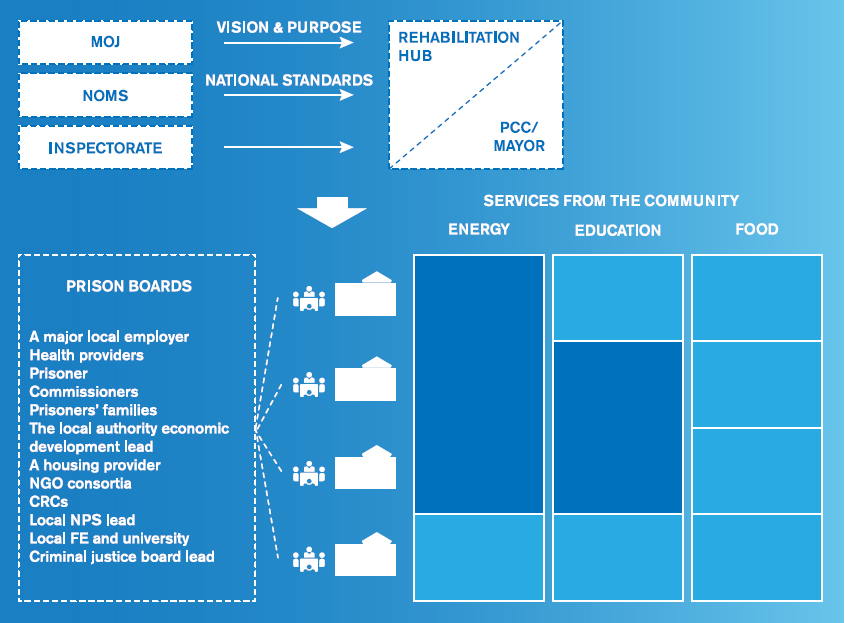
As shown in the below diagram, prison governors, guided by local
boards, will be given new freedoms to commission services such as food,
education, and energy. The diagram attempts to convey the opportunity
for prisons to work together, and form clusters (when they feel this is
appropriate), but this will be their choice and, ultimately, they will
be held accountable for the outcomes, alongside local prison boards
The Report Recommendations
The Ministry of Justice should publish a 2017–2020 National Rehabilitation Strategy.
This
should focus on reducing risk and strengthening rehabilitation,
prioritise integration between prisons and probation and have the
explicit support of other departments, including the Treasury, the
Department of Health, the Home Office, the Department for Communities
and Local Government and the Department for Work and Pensions. The
strategy should seek to drive long-term system change and prioritise the
following 10 key changes:
Create a Rehabilitation Requirement — The
government’s white paper should include a rehabilitation requirement
for prisons and probation. This should be a legal duty and require
prisons and probation to track individual and institutional progress in
relation to rehabilitation
Return frontline staffing to 2010 levels — As
a foundation of reform, additional investment is urgently needed to
reduce security and safety risks and to protect prisoners and frontline
workers.
A 2020 Rehabilitative Workforce Plan — Linked
to new recruitment, this should develop a new training offer, skills
strategy and career paths for prison officers and focus on developing a
rehabilitative workforce with transferable skills across prisons and
probation.
A Centre of Prisons Excellence — Delivered
through an ambitious model for the current training centre, Newbold
Revel, this should learn from the College of Policing and consideration
should be given to a centre working across prisons and probation.
An arms-length, more independent NOMS — NOMS
should become a smaller arms-length function with greater independence
from the Ministry of Justice. This would focus on resilience issues such
as population management, the high-security estate and particular
security issues.
An enhanced and more Integrated Prison and Probation Inspection Regime — This
should include making the prisons inspectorate compliant with the
obligations from OPCAT (Optional Protocol to the Convention against
Torture), which should be put on a statutory footing. The inspectorates
should develop consistency on assessing rehabilitative outcomes such as
education, employment and family relationships and introduce outcomes on
leadership and management. A review of Independent Monitoring Boards (IMBs) should be undertaken to explore the potential of developing their role to track inspection recommendations.
Creation of Local Prison Boards — In
developing greater autonomy, stability and ensuring safety and risk are
managed, the National Offender Management Service (NOMS) should hand
over prison funding to local boards and prison governors with some key
obligations that ensure that the national resilience work and population
flow is mandated. Local prison boards would oversee long-term strategy
and should aim to increase governors’ tenure as appropriate. Such a move
would retain the national prison service but enable greater local
control, including the development of special purpose vehicles to drive
innovation and integration, and secure additional funding from
private/corporate/charitable partnerships. The local prison board could
include representation from a major employer in the area, health
providers and commissioners, prisoners’ families, the local authority
economic development lead, a housing provider, NGO consortia, Community
Rehabilitation Companies (CRCs), the local FE and university, the
National Probation Service (NPS), the area criminal justice board lead
and a member of the prison’s rehabilitative council.
New devolved powers for governors and PCCs — In giving governors greater freedoms and introducing more local autonomy, the government should adopt a staged process of devolution
with a focus on expanding the remit of Police and Crime Commissioners
(PCCs) and ensuring that scrutiny arrangements are in place to take on
wider responsibilities and risk. In the interim, Regional Rehabilitation
Boards would be responsible for developing Regional Rehabilitation
Strategies 2017–2020 in line with the national strategy and vision of
the new Rehabilitation Requirement.
Integration of Health Services — In
addition to involving Public Health England and the NHS in developing
more devolved arrangements, the government should ensure that Joint
Strategic Needs Assessments (JSNA) provide clear statutory guidance on
people on licence in the community, and those in custody, and that
Health and Wellbeing Boards be instructed to include prisoner
populations explicitly in their priorities.
Designing in Rehabilitation — The
government’s prison building programme should be informed by first
principles and by evidence of what supports rehabilitation, including
size, locality, available networks and employment.
A Matter of Conviction argues that this model will ultimately serve to create a self-improving, more cost effective and innovative system.
Download the report - A Matter of Conviction (PDF, 5MB)
Read the blog - Rehabilitation is key to reducing risk in the prison system
Download the report - A Matter of Conviction (PDF, 5MB)
COMMENTS

Brackenbury What about a Protest outside liz trusses office, let's say April time, in school holidays so children can come too, who's in??? We need at least a few thousand, which is highly achievable if every ipps family brought at least 3-4 people with them, I totally understand some struggle with getting there due to cost or distance, but we are at a point now where we've tried pretty much everything and got nowhere, it's time this lady saw the amount of people it affects, the children, partners, mums, dad's, sisters, brothers, aunts, uncles, and their friends too,
I feel we have to give this a go, I'm sure there are people who can share the journey on here with others, if we all help each other, could organise coaches if there's alot of people from certain areas, it may cost us money, but it's a one off for those we are fighting for, surely they are worth every effort, these men are taking their lives now with still no end in sight, we are all they have and so many of us are doing nothing, so please, grab your family/friends and we can do this, but we need to make alot of noise now! Can people who will deffo come We are going to contact the inside times and ask for a post on their site to spread it to a wider audience, maybe contact a few organisations and the media, if anyone has any contacts or can help with anything that will be great! Also suggestions for an exact date would be good, will have to be a week day as we've all seen she doesn't give up her weekends!!
If we all write our personal letters explaining our pain and misery and that of our ipps to of course!... We can drop it In her little post box while we are there.As much as Michael Gove has rattled my cage in recent years, even he has taken the time to give extensive thought to the state of prisons and the rights and wrongs, so for that I applaud him, he's hit every point in this statement....
I feel we have to give this a go, I'm sure there are people who can share the journey on here with others, if we all help each other, could organise coaches if there's alot of people from certain areas, it may cost us money, but it's a one off for those we are fighting for, surely they are worth every effort, these men are taking their lives now with still no end in sight, we are all they have and so many of us are doing nothing, so please, grab your family/friends and we can do this, but we need to make alot of noise now! Can people who will deffo come We are going to contact the inside times and ask for a post on their site to spread it to a wider audience, maybe contact a few organisations and the media, if anyone has any contacts or can help with anything that will be great! Also suggestions for an exact date would be good, will have to be a week day as we've all seen she doesn't give up her weekends!!
If we all write our personal letters explaining our pain and misery and that of our ipps to of course!... We can drop it In her little post box while we are there.As much as Michael Gove has rattled my cage in recent years, even he has taken the time to give extensive thought to the state of prisons and the rights and wrongs, so for that I applaud him, he's hit every point in this statement....
dullman I am going to send a letter to probation he needs to be near us me and kids if release is granted and give them a list of hostels to look at that ain't to far from us. Last thing we need is him far away emough 10 yrs and missed out on bringing our kids up they were babies when he went in and toddlers.10 year with a 10 month tariff!
Horton And as I've said before, at least Michael Gove actually DID something while he was Justice Secretary. He didn't just mouth cliches. As a teacher who saw the mess Gove made of the education system, I was expecting more of the same when he became Justice Secretary. But he surprised me - and he has consistently said all the things in this article, right from the start, and he tried to sbegin putting them into practice. Then he self destructed and we got Liz Truss....
Wheeler
Hello everyone, I have not been keeping up to date for a while, things all got a bit too much and I needed to step back a bit. I can't say too much but this is a bit of a ray of hope for all of us. Someone who was on an IPP from about 10 years ago was up before the Parole Board recently and to his complete shock without warning was released a couple of days after. I can't reveal any more but it renwed my hope that people are albeit slowly getting released and I thought I would share.
EdmeadCant believe a good friend of mine has his parole date..
Reland At least more inside staff are speaking out.
Foster I was planning a protest as my partner wasn't being moved to make the progress he needed to so they obviously didn't want a protest because of riots .
Brackenbury
Protest outside liz trusses office, let's say April time, in school holidays so children can come too, who's in??? We need at least a few thousand, which is highly achievable if every ipps family brought at least 3-4 people with them, I totally understand some struggle with getting there due to cost or distance, but we are at a point now where we've tried pretty much everything and got nowhere, it's time this lady saw the amount of people it affects, the children, partners, mums, dad's, sisters, brothers, aunts, uncles, and their friends too,
I feel we have to give this a go, I'm sure there are people who can share the journey on here with others, if we all help each other, could organise coaches if there's alot of people from certain areas, it may cost us money, but it's a one off for those we are fighting for, surely they are worth every effort, these men are taking their lives now with still no end in sight, we are all they have and so many of us are doing nothing, so please, grab your family/friends and we can do this, but we need to make alot of noise now! Can people who will deffo come please comment, and any questions please comment below or ask me or natasha,
We are going to contact the inside times and ask for a post on their site to spread it to a wider audience, maybe contact a few organisations and the media, if anyone has any contacts or can help with anything that will be great! Also suggestions for an exact date would be good, will have to be a week day as we've all seen she doesn't give up her weekends!!
If we all write our personal letters explaining our pain and misery and that of our ipps to of course!... We can drop it In her little post box while we are there.As much as Michael Gove has rattled my cage in recent years, even he has taken the time to give extensive thought to the state of prisons and the rights and wrongs, so for that I applaud him, he's hit every point in this statement....
dullman I am going to send a letter to probation he needs to be near us me and kids if release is granted and give them a list of hostels to look at that ain't to far from us. Last thing we need is him far away emough 10 yrs and missed out on bringing our kids up they were babies when he went in and toddlers.10 year with a 10 month tariff!
Protest outside liz trusses office, let's say April time, in school holidays so children can come too, who's in??? We need at least a few thousand, which is highly achievable if every ipps family brought at least 3-4 people with them, I totally understand some struggle with getting there due to cost or distance, but we are at a point now where we've tried pretty much everything and got nowhere, it's time this lady saw the amount of people it affects, the children, partners, mums, dad's, sisters, brothers, aunts, uncles, and their friends too,
I feel we have to give this a go, I'm sure there are people who can share the journey on here with others, if we all help each other, could organise coaches if there's alot of people from certain areas, it may cost us money, but it's a one off for those we are fighting for, surely they are worth every effort, these men are taking their lives now with still no end in sight, we are all they have and so many of us are doing nothing, so please, grab your family/friends and we can do this, but we need to make alot of noise now! Can people who will deffo come please comment, and any questions please comment below or ask me or natasha,
We are going to contact the inside times and ask for a post on their site to spread it to a wider audience, maybe contact a few organisations and the media, if anyone has any contacts or can help with anything that will be great! Also suggestions for an exact date would be good, will have to be a week day as we've all seen she doesn't give up her weekends!!
If we all write our personal letters explaining our pain and misery and that of our ipps to of course!... We can drop it In her little post box while we are there.As much as Michael Gove has rattled my cage in recent years, even he has taken the time to give extensive thought to the state of prisons and the rights and wrongs, so for that I applaud him, he's hit every point in this statement....
I feel we have to give this a go, I'm sure there are people who can share the journey on here with others, if we all help each other, could organise coaches if there's alot of people from certain areas, it may cost us money, but it's a one off for those we are fighting for, surely they are worth every effort, these men are taking their lives now with still no end in sight, we are all they have and so many of us are doing nothing, so please, grab your family/friends and we can do this, but we need to make alot of noise now! Can people who will deffo come please comment, and any questions please comment below or ask me or natasha,
We are going to contact the inside times and ask for a post on their site to spread it to a wider audience, maybe contact a few organisations and the media, if anyone has any contacts or can help with anything that will be great! Also suggestions for an exact date would be good, will have to be a week day as we've all seen she doesn't give up her weekends!!
If we all write our personal letters explaining our pain and misery and that of our ipps to of course!... We can drop it In her little post box while we are there.As much as Michael Gove has rattled my cage in recent years, even he has taken the time to give extensive thought to the state of prisons and the rights and wrongs, so for that I applaud him, he's hit every point in this statement....
https://www.thersa.org/discover/publications-and-articles/reports/a-matter-of-conviction-a-blueprint-for-community-based-prisons
https://medium.com/rsa-reports/a-matter-of-conviction-a-blueprint-for-community-based-rehabilitative-prisons-e56676c96083#.lzclvmxhn
https://www.theguardian.com/commentisfree/2016/nov/03/i-spent-20-years-in-jail-hiring-officers-wont-solve-crisis
.


